In a new paper, we examined the stimulus design of 104 underwater sound exposure studies published between 2019 and 2023.
We found that most studies relied on a single sound treatment to represent an entire class of sounds, such as boat noise. That matters because any one recording can contain unique characteristics or unintended background noise, making it potentially a poor representative for ‘boat noise’ in general. Even among studies that used multiple sound treatments, many did not account for that structure statistically. Because of this, conclusions are often broader than the experimental design really supports.
Our goal is not to criticize individual studies, but to help move the field forward. Underwater sound experiments are often logistically difficult and expensive, especially in the field. At the same time, a few changes can make results more robust and more generalizable. As underwater noise research continues remains relevant, we hope this paper helps strengthen the foundation for future studies.
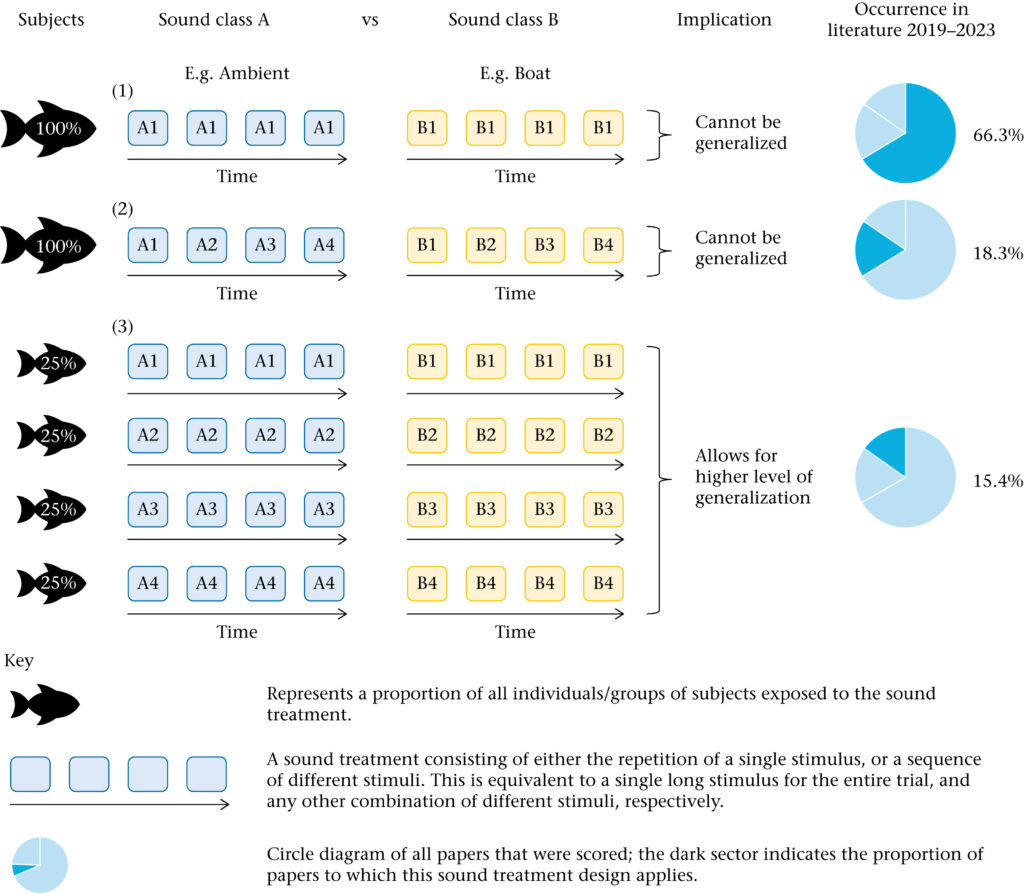
Read all about it in the paper: Hubert, J., Willems, M., & Varkevisser, J. M. (2024) Pseudoreplication of sound treatments in underwater exposure studies. Anim. Beh. 215, 125-130.